



Trace how the sector became what it is today: its origins, stalwarts, catastrophes and triumphs.
Industry Essentials 5.0
Certificate in Industry Essentials 5.0: Humanitarian and Global Health
IEHG · Humanitarian and Global Health
How the sector works, what governs it, where its risks sit and how supply chain and procurement create value within it. Free to every member, with a certificate of completion.
Industry Essentials 5.0
Humanitarian and Global Health
20 modules
Self-paced study
60 hours
Guided learning time
Free course
Certificate of completion
About This Course
A grounded understanding of Humanitarian and Global Health: how the sector operates, how Industry 5.0 is changing it and why supply chain and procurement capability decides whether that change succeeds.
Skills You Will Build
Explain how the sector actually operates: where the money flows, who the players are and what the rulebook demands.
Describe Industry 5.0 and its three values of human-centricity, resilience and sustainability, and where they have genuinely landed in this sector.
Recognize why supply chain and procurement capability decides whether the sector’s transformation succeeds.
Assess your own organization against the three Industry 5.0 values and its sector risk profile.
See where the SCPMI professional community and its case studies close the sector-depth gap.
CORE TOPICS
- Humanitarian and Global Health Fundamentals and Terminology
- Planning and Demand Management in the Humanitarian and Global Health Sector
- Sourcing, Supplier Selection and Contract Basics
- Supplier Performance, Risk and Continuity
- Cost, Value and Commercial Decision-Making
- Data, Digital Tools and Professional Judgment
Who this course is for
For supply chain and procurement professionals working in or moving into humanitarian and global health work, from those early in their careers who want a structured grounding to experienced practitioners who want to see the whole sector in one place.
No prior qualification is needed. Employers can use it to give a whole team a shared understanding of the sector.
Procurement and Sourcing
Buying relief items, medicines, fleet and freight
Supply Chain and Planning
Planning supply against funding cycles and access
Supplier Management
Holding suppliers, freight forwarders and partners to a standard
Last-Mile Delivery
Getting supplies to the people who need them
Donor Compliance
Meeting the rules that follow restricted funding
Emergency Response
Sourcing at speed when a crisis starts
IEHG Curriculum
20 modules60 guided hours
- 1. Before There Was Humanitarian Work2. The People Who Built Humanitarian Work3. The Catastrophe That Wrote the Humanitarian Rulebook4. What Humanitarian Work Got Spectacularly Right5. Humanitarian Work: Booms, Busts and Absurdities
- 1. Follow the Money in Humanitarian Work2. Humanitarian Work From One End to the Other3. The Humanitarian Supply Base and Everyone in the Room4. Commercial and Data Norms in Humanitarian Work5. The Humanitarian Rulebook and Its Enforcers
- 1. The People Who Do the Work in Humanitarian Work2. What Is Industry 5.0, and What Does It Mean for Humanitarian Work?3. Robots, Algorithms and People in Humanitarian Work4. What the Machines Are Actually Doing in Humanitarian Work5. The Bill Arrives: The Humanitarian Environmental Account
- 1. Built to Bend: Resilience in Humanitarian Work2. Who Actually Decides in Humanitarian Work?3. In Humanitarian Work, the Chain Is the Business4. What Humanitarian Work Now Requires, and Why Depth Wins5. An Honest Look at Your Own Humanitarian Operation
Four parts, following the journey from donor to last mile through supply chain, sourcing and procurement, with 91 case studies along the way.
Built for Real Humanitarian and Global Health Work
Case-Based Learning
Real humanitarian and global health cases, each with its published source, so you see how the decision actually went.
Knowledge Checks
211 checks across the course, asking about the case you just read rather than the definition.
Story-Led Decisions
91 decision points where you make the call first, then see what the organization really did.
Glossary Flashcards
A flashcard set for every module, built from the 153 terms this course defines.
Choose how you learn
Self-paced online
Start when you like and finish at your own pace
With your industry community
Ask questions and compare notes with people doing the same work
As a team
Enroll your whole team and give them one shared understanding of the sector

Show the sector depth you have built
Retail demand planning is not humanitarian logistics. Construction procurement is not technology sourcing.
Every industry has its own regulations, supplier markets, risks, technologies and measures of performance. A qualification designed to apply everywhere cannot reflect the reality of any one of them.
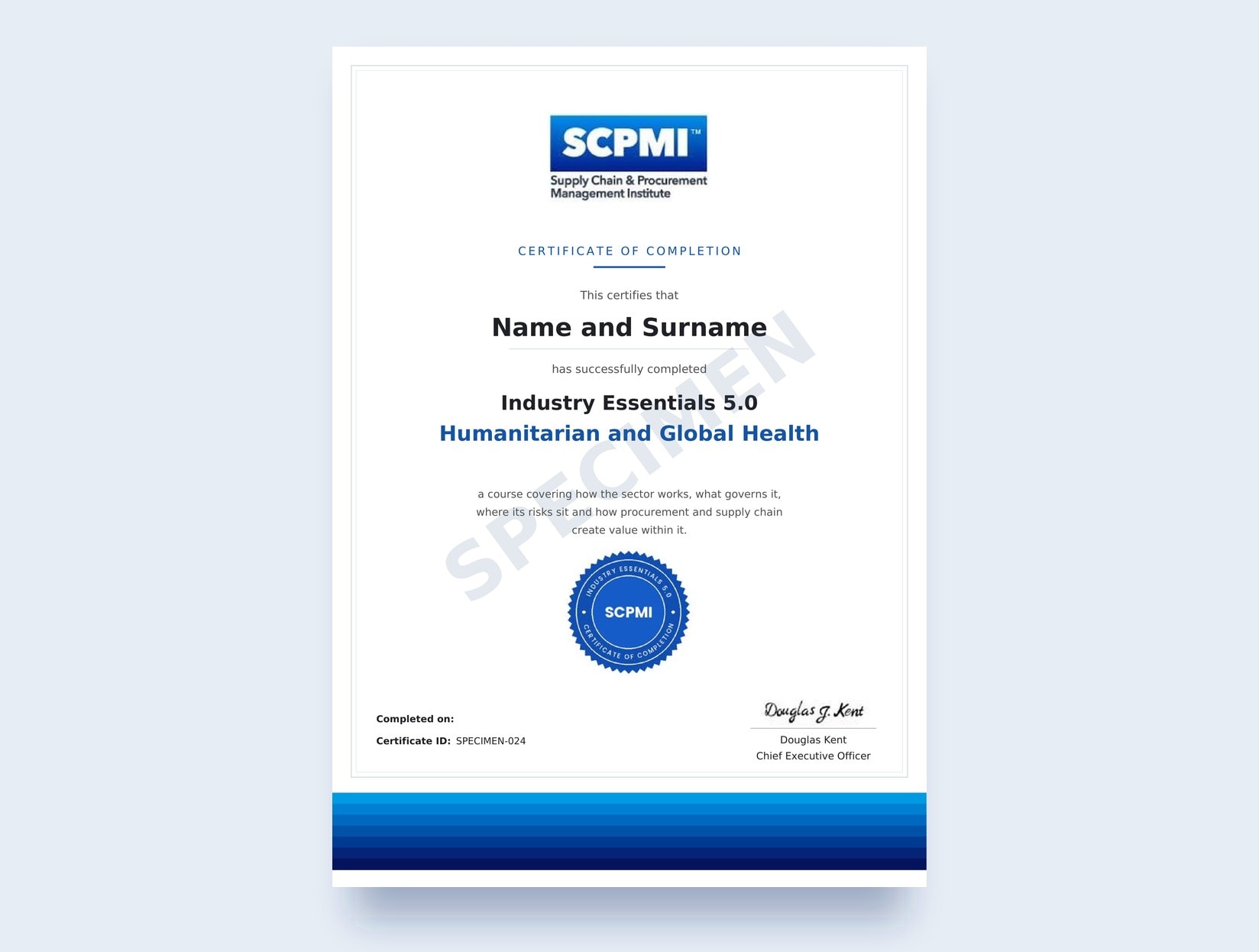
Digital certificate
Certificate ID
On your member profile
Yours to share
FREQUENTLY ASKED QUESTIONS
Everything You Need to Know About Industry Essentials 5.0
Quick answers on what it costs, how long it takes and what you hold at the end.
Nothing. Industry Essentials 5.0 is free to every SCPMI member, and membership is free.
20 modules and around 60 guided hours. It is self-paced, so you set the speed.
A digital certificate of completion with its own certificate ID, yours to share and shown on your member profile.
No. It is a course with a certificate of completion. SCPMI certifications are assessed and are held separately.
No. It is written for people entering the sector and for practitioners who want the whole sector in one place.
Build your capability in humanitarian and global health work
Join the professionals in your industry, put your questions to people who have solved them and keep growing.
